---
title: "Reading notes: From Lucene to Elasticsearch: full-text search in practice"
description: "Notes cover only the Elasticsearch search parts"
date: 2018-12-30
tags: ["elasticsearch","dsl","kibana"]
lang: en
url: https://bugs.cc/posts/reading-notes-from-lucene-to-elasticsearch-full-text-search/
translation: https://bugs.cc/zh/posts/reading-notes-from-lucene-to-elasticsearch-full-text-search/
---
# Reading notes: From Lucene to Elasticsearch: full-text search in practice
## From Lucene to Elasticsearch: full-text search in practice
These notes only cover the search parts of `Elasticsearch`.
All searches in this post were run in `kibana` `Dev tools`.
### Preparation
You need `Elasticsearch`, `kibana`, and `elasticsearch-analysis-ik` installed.
I will not go into the install steps here. (After installing, remember to restart `Elasticsearch`.)
Once it is back up, open `kibana` `Dev tools`, paste the DSL below, and run it:
```js
PUT books
{
"settings": {
"number_of_replicas": 1,
"number_of_shards": 3
},
"mappings": {
"IT": {
"properties": {
"id": {
"type": "long"
},
"title": {
"type": "text",
"analyzer": "ik_max_word"
},
"language": {
"type": "keyword"
},
"author": {
"type": "keyword"
},
"price": {
"type": "double"
},
"year": {
"type": "date",
"format": "yyyy-MM-dd"
},
"description": {
"type": "text",
"analyzer": "ik_max_word"
}
}
}
}
}
```
After that, save the following as `books.json`:
```jsonl title="books.json"
{"index":{ "_index": "books", "_type": "IT", "_id": "1" }}
{"id":"1","title":"Java编程思想","language":"java","author":"Bruce Eckel","price":70.20,"publish_time":"2007-10-01","description":"Java学习必读经典,殿堂级著作!赢得了全球程序员的广泛赞誉。"}
{"index":{ "_index": "books", "_type": "IT", "_id": "2" }}
{"id":"2","title":"Java程序性能优化","language":"java","author":"葛一鸣","price":46.50,"publish_time":"2012-08-01","description":"让你的Java程序更快、更稳定。深入剖析软件设计层面、代码层面、JVM虚拟机层面的优化方法"}
{"index":{ "_index": "books", "_type": "IT", "_id": "3" }}
{"id":"3","title":"Python科学计算","language":"python","author":"张若愚","price":81.40,"publish_time":"2016-05-01","description":"零基础学python,光盘中作者独家整合开发winPython运行环境,涵盖了Python各个扩展库"}
{"index":{ "_index": "books", "_type": "IT", "_id": "4" }}
{"id":"4","title":"Python基础教程","language":"python","author":"Helant","price":54.50,"publish_time":"2014-03-01","description":"经典的Python入门教程,层次鲜明,结构严谨,内容翔实"}
{"index":{ "_index": "books", "_type": "IT", "_id": "5" }}
{"id":"5","title":"JavaScript高级程序设计","language":"javascript","author":"Nicholas C. Zakas","price":66.40,"publish_time":"2012-10-01","description":"JavaScript技术经典名著"}
```
Then import it. If your `Elasticsearch` version is below `6.0`, import `books.json` with:
```bash
curl -XPOST "http://localhost:9200/_bulk?pretty" --data-binary @books.json
```
If your `Elasticsearch` version is above `6.0`, import with:
```bash
curl -H "Content-Type: application/json" -XPOST "http://localhost:9200/_bulk?pretty" --data-binary @books.json
```
### Basic search
#### Return all documents in an index
```js
GET books/_search
{
"query": {
"match_all": {}
}
}
```
You can shorten it to:
```js
GET books/search
```
#### Find documents whose field contains a given word
Use `term` to query. A `term` query is not analyzed; the search term has to match a term in the document exactly. Typical uses: names, places, anything that needs an exact match.
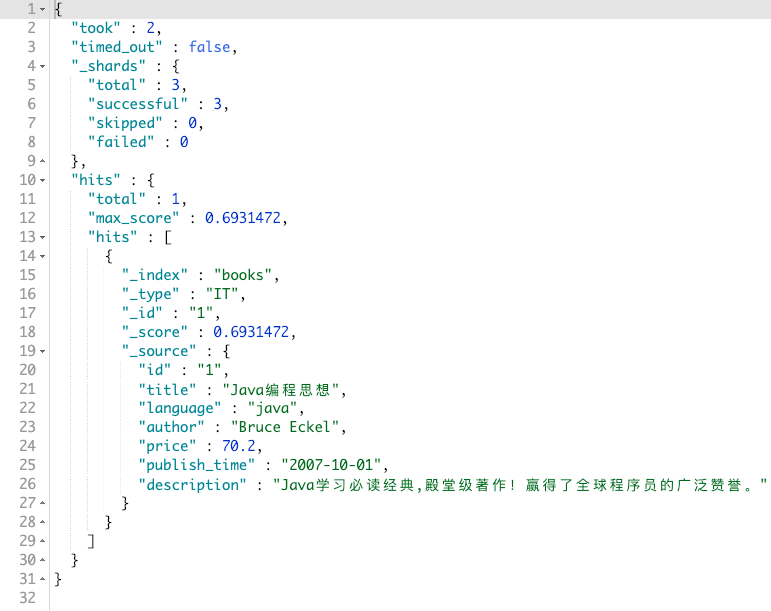
Find books whose title field contains `思想`:
```js
GET books/_search
{
"query": {
"term": {
"title": "思想"
}
}
}
```
The result:
#### Paginate the results
Sometimes a query returns thousands of hits. That is where pagination comes in.
Pagination has two properties, `from` and `size`:
- from: where to start
- size: max number of documents to return
You can think of it as: start at `from` and return the rest of the documents, then `size` caps how many you actually get back.
In JS that would look like:
```js
const from = 100 - 1; // arrays start at 0, so subtract one
const size = 10;
const data = [1, 2, 3, ..., 999, 1000];
const fromDate = data.splice(from);
const result = fromData.splice(0, size);
console.log(result) //=> [100, 101, 102, 103, 104, 105, 106, 107, 108, 109]
```
#### Limit returned fields
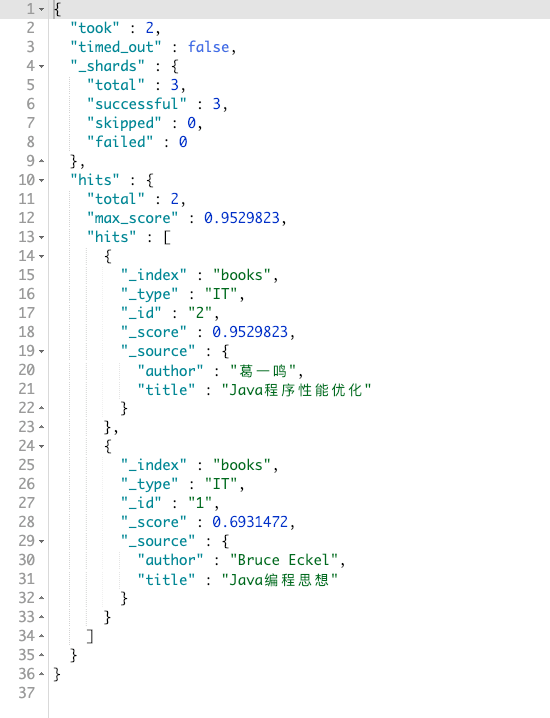
Usually we query to look at a few fields, not every field. By default `Elasticsearch` returns all fields of a document, which can get in the way. So `Elasticsearch` provides a way to limit the returned fields. Say I only need `title` and `author`:
```js
GET books/_search
{
"_source": ["title", "author"],
"query": {
"term": {
"title": "java"
}
}
}
```
The result:
#### Filter by a minimum score
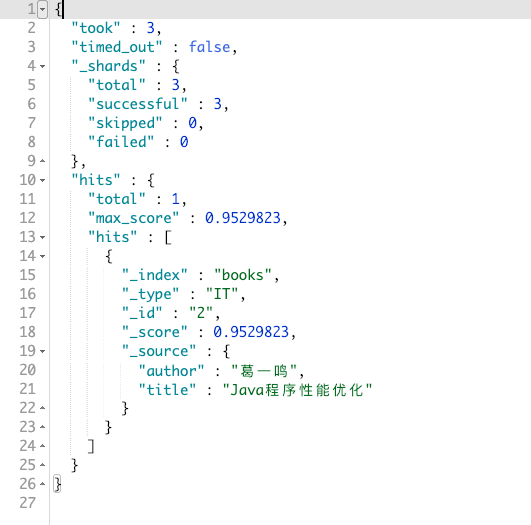
Ordinary `Elasticsearch` search is relevance-based, and relevance comes from the `score`. On a fuzzy search, `Elasticsearch` may return documents that are not that relevant. You can set a minimum score, and documents below that score will not show up.
For example, I want documents whose `title` contains `java`, with a score of at least `0.7`:
```js
GET books/_search
{
"min_score": 0.7,
"query": {
"term": {
"title": "java"
}
}
}
```
The result:
#### Highlight keywords
Sometimes we import `Elasticsearch` results directly into a web page. Then we want keywords highlighted so the user can see more clearly what they searched for. `Elasticsearch` already has an API for this. Say I want keywords in the results highlighted:
```js
GET books/_search
{
"_source": ["title"],
"min_score": 0.7,
"query": {
"term": {
"title": "java"
}
},
"highlight": {
"fields": {
"title": {}
}
}
}
```
The result:
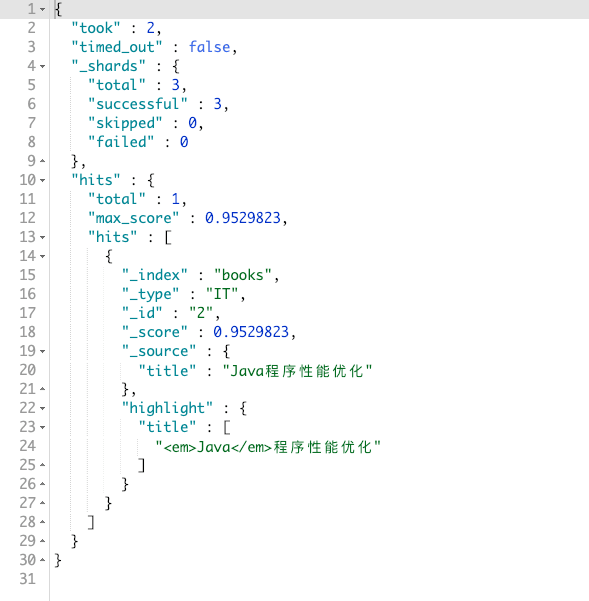
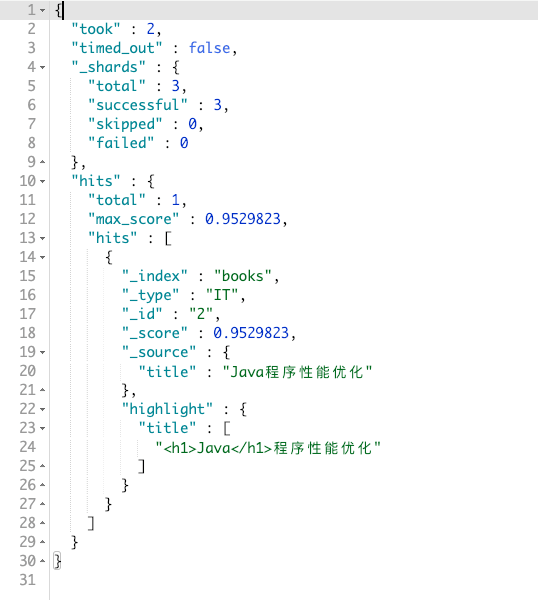
The default tags are ``. To customize them, use `pre_tags` and `post_tags`. The full query:
```js
GET books/_search
{
"_source": ["title"],
"min_score": 0.7,
"query": {
"term": {
"title": "java"
}
},
"highlight" : {
"pre_tags" : [""],
"post_tags" : ["
"],
"fields" : {
"title" : {}
}
}
}
```
The result:
### Full-text queries
The previous section mostly searched with `term`, but `Elasticsearch` has many search methods. This chapter is about those methods and what each one does.
I am skipping `common_terms query`, `query_string query`, and `simple_query_string query`. They are used less often, and they take more explaining. If you want to know more, look them up online. I will not go into them here.
#### match query
First, a `term` query:
```js
GET books/_search
{
"_source": ["title", "author"],
"query": {
"term": {
"title": "java编程"
}
}
}
```
You will see that the result is empty (the data is in the index, though):
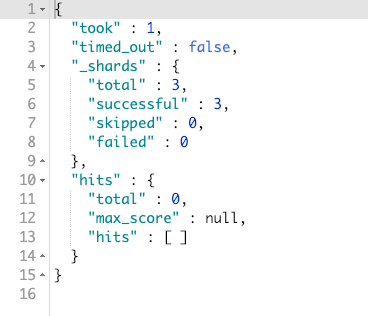
That is because `term` matches against analyzed terms. The `java编程` we just searched is analyzed into `java` and `编程`, so the whole string does not match.
In code:
```js
const keyword = 'java编程';
const data = ['java', '编程'];
const result = data.includes(keyword);
console.log(result) //=> false
```
Now try swapping `term` for `match`:
```js
GET books/_search
{
"_source": ["title", "author"],
"query": {
"match": {
"title": "java编程"
}
}
}
```
The result:
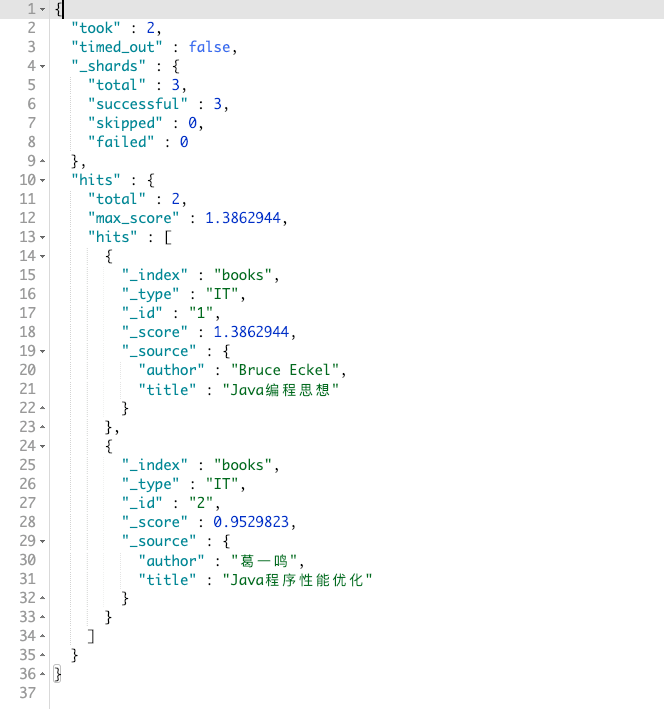
There are hits now. Why two of them?
Because `match` analyzes your keywords, then matches them against the analyzed terms in the document. If any analyzed term from the document matches any analyzed term from the keyword, the document is returned.
In code:
```js
const data = ['java', '编程', '思想']; // the document's terms after analysis
const keywords = ['java', '编程', '思想']; // the keywords after analysis
const result = (() => {
for (let x = 0; x < data.length; x++) {
const dataItem = data[x];
for (let y = 0; y < keywords.length; y++) {
const keywordItem = keywords[y];
if (dataItem === keywordItem) {
return true;
}
}
}
return false;
})()
```
What if I only want one hit, and I still have to use `match`? Is that possible?
Yes. `match` has an `operator` property that can do this:
```js
GET books/_search
{
"_source": ["title", "author"],
"query": {
"match": {
"title": {
"query": "java编程",
"operator": "and"
}
}
}
}
```
The result:
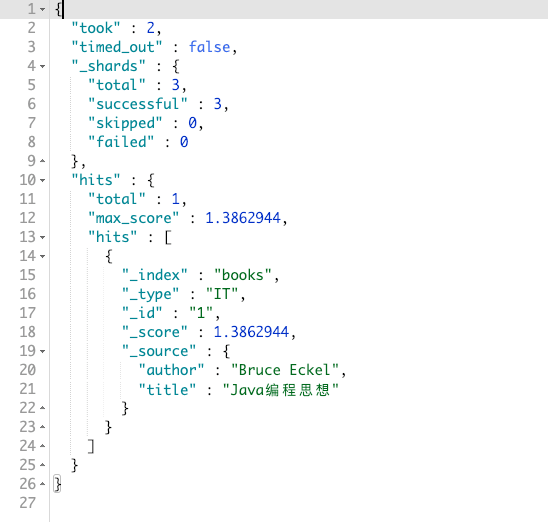
The idea is that `operator` is `and`, which tells `Elasticsearch` that every keyword term must match a term in the document. Miss one and I do not want it.
If `operator` is `or`, the result is the same as before.
#### match_phrase query
You can think of this as `match` with `operator` already set to `and`.
It has two constraints. Both must hold for a document to show up:
- Every analyzed term is in the field, same as `operator: "and"`
- The order has to match
What does order mean?
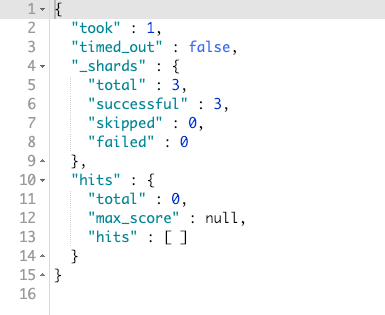
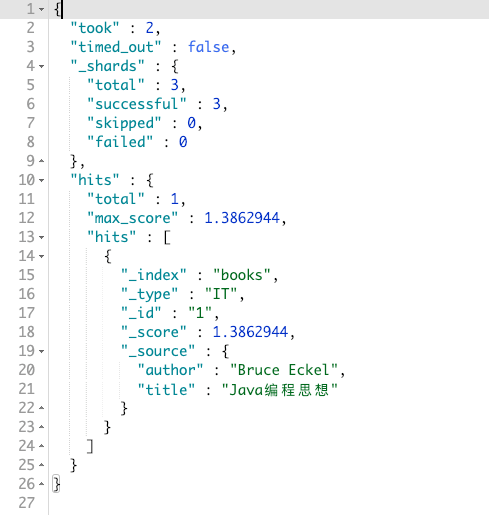
If you use `match` with `编程java`, you still get the same result as above. If you need the order to match, use `match_phrase`.
Searching `编程java`:
Searching `java编程`:
#### match_phrase_prefix query
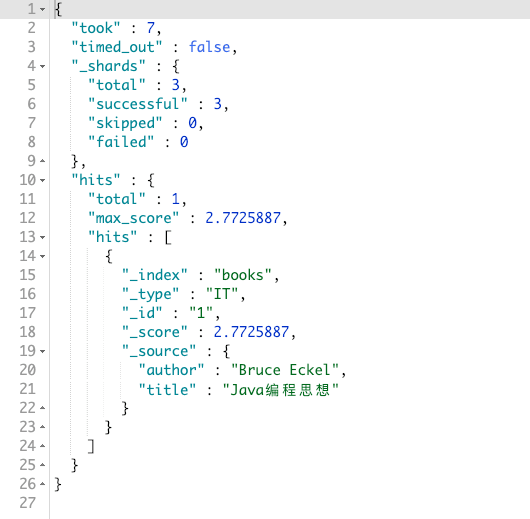
This is similar to `match_phrase`, except the last term is used as a prefix. Picture a user typing `辣鸡UZ` in the search box, and `辣鸡UZI` showing up in the dropdown.
First `match_phrase_prefix` analyzes the input into `辣鸡`, finds a document, then checks whether the string after `辣鸡` starts with `UZ`. If it does, the document is a hit. You can picture a `(.*)` wildcard stuck on the end, like `辣鸡UZ(.*)`.
Knowing that, here is a query:
```js
GET books/_search
{
"_source": ["title", "author"],
"query": {
"match_phrase_prefix": {
"title": "java编"
}
}
}
```
The result:
#### multi_match query
`multi_match` is an upgrade of `match`. It searches multiple fields.
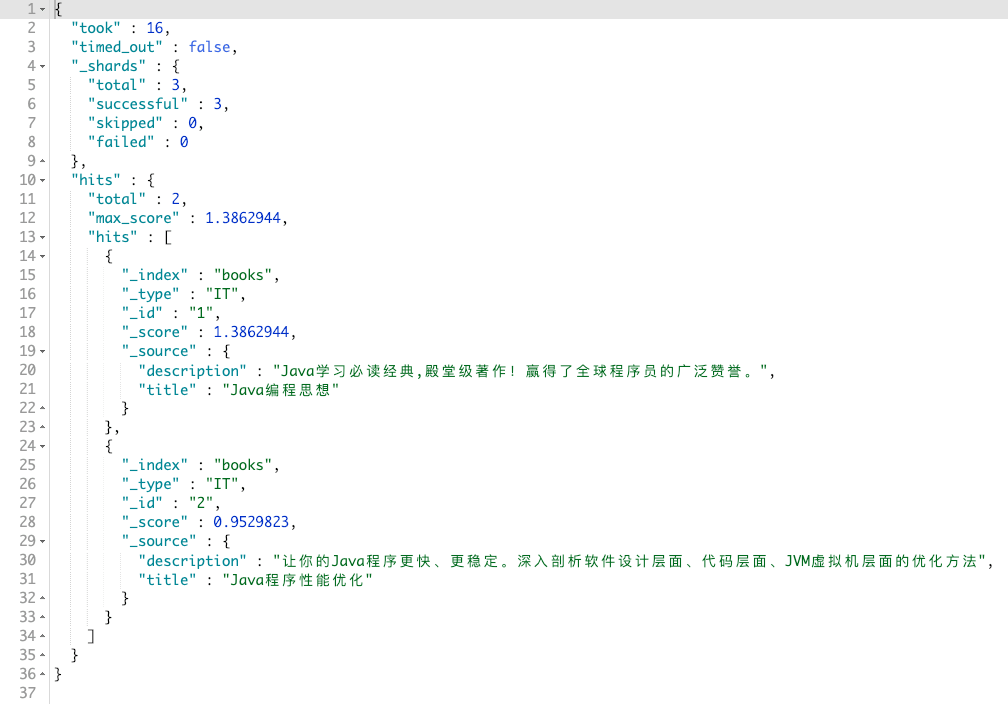
Say I do not want to search only `title` for `java编程`; I also want to search `description`. How?
`Elasticsearch` already has `multi_match` for this:
```js
GET books/_search
{
"_source": ["title", "description"],
"query": {
"multi_match": {
"query": "java编程",
"fields": ["title", "description"]
}
}
}
```
The result:
`multi_match` also supports wildcards. The query above can be written as:
```js
GET books/_search
{
"_source": ["title", "description"],
"query": {
"multi_match": {
"query": "java编程",
"fields": ["title", "*tion"]
}
}
}
```
### Term queries
The previous chapter was full-text queries. This one is term queries. The difference:
- Full-text queries: analyze the query, then match against analyzed terms in the document
- Term queries: do not analyze the query
#### term query
I already covered this in the first chapter, so I will not go into it again.
#### terms query
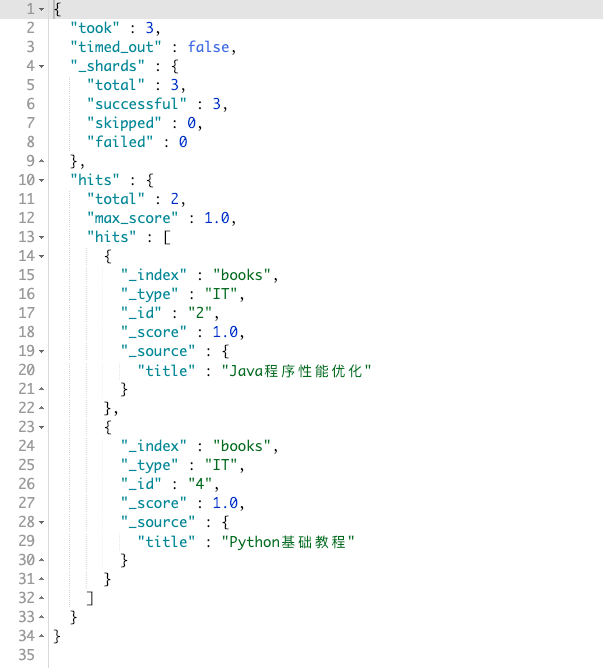
`terms` is an upgrade of `term`. It checks whether a field contains any of the given keywords. For example, documents whose `title` contains `优化` or `基础`:
```js
GET books/_search
{
"_source": ["title"],
"query": {
"terms": {
"title": ["优化", "基础"]
}
}
}
```
The result:
#### range query
You can guess from the name that `range` is range matching. It can match `number`, `date`, and `string` (string range queries are a bit special and not used much, so I will skip them).
`range` supports these parameters:
- gt: greater than
- gte: greater than or equal
- lt: less than
- lte: less than or equal
##### number range query
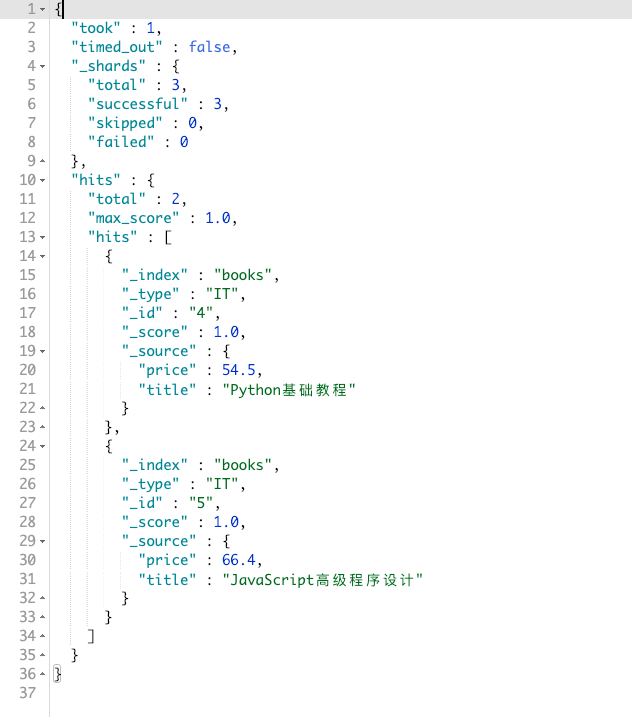
I want books priced below 70 and at least 50. In pseudocode: `(price >= 50 && price < 70)`:
```js
GET books/_search
{
"_source": ["title", "price"],
"query": {
"range": {
"price": {
"gte": 50,
"lt": 70
}
}
}
}
```
The result:
##### date range query
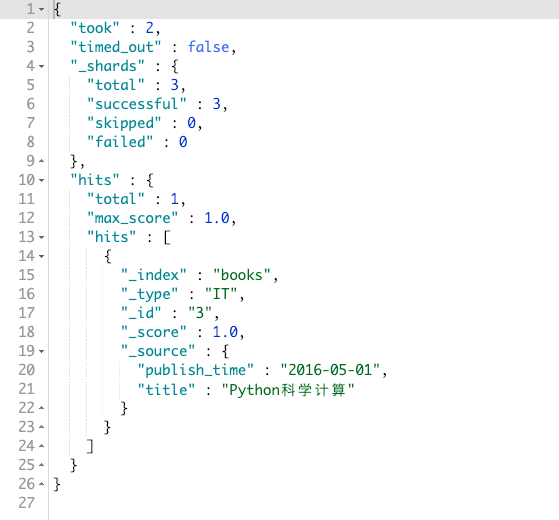
If I want books published between `2016-1-1` and `2016-12-31`, the DSL looks like this:
```js
GET books/_search
{
"_source": ["title", "publish_time"],
"query": {
"range": {
"publish_time": {
"gte": "2016-1-1",
"lte": "2016-12-31",
"format": "yyyy-MM-dd"
}
}
}
}
```
The result:
#### exists query
Matches documents that have this field. For example, documents that have a `title` field:
```js
GET books/_search
{
"_source": "title",
"query": {
"exists": {
"field": "title"
}
}
}
```
The result returns every document. So how do we define "has this field"?
The rules:
- `{"title": "js"}`: exists
- `{"title": ""}`: exists
- `{"title": ["js"]}`: exists
- `{"title": ["js", null]}`: exists (one non-empty value is enough)
- `{"title": null}`: does not exist
- `{"title": []}` does not exist
- `{"title": [null]}` does not exist
- `{"foo": "bar"}`: does not exist
#### prefix query
Matches the prefix of analyzed terms in the document. First, a DSL query:
```js
GET books/_search
{
"_source": "description",
"query": {
"prefix": {
"description": "wi"
}
}
}
```
The result:
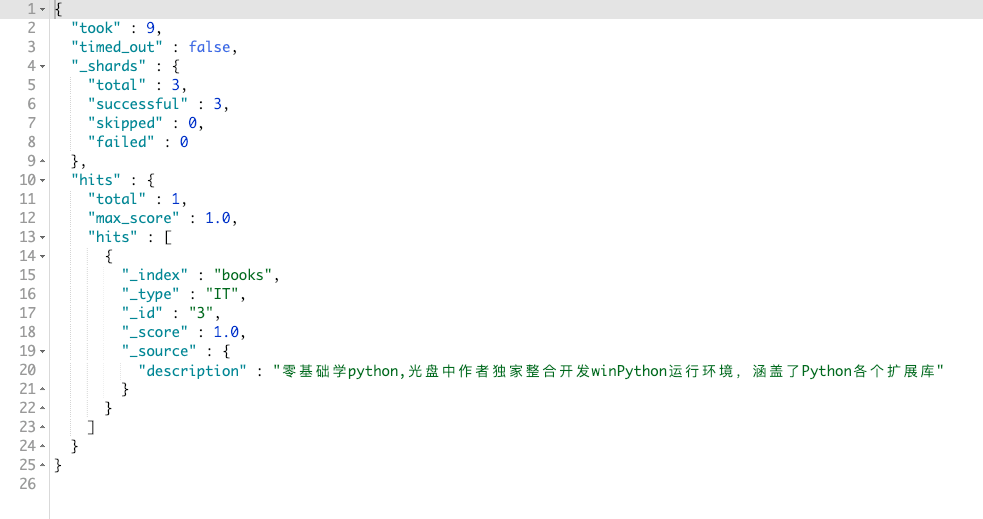
Why can `wi` match this? Because `Elasticsearch` analyzes `description`, and it splits `winPython` into `win` `Python`. Those two are the analyzed terms, and `prefix` checks whether each term starts with the keyword, like JS `startsWith`. In code:
```js
const dataItem = ['win', 'python'];
const prefixKeyword = 'wi';
const result = dataItem.some(item => item.startsWith(prefixKeyword));
console.log(result); //=> true
```
#### wildcard query
`wildcard` is a wildcard query. Right now it only supports `*` and `?`:
- `*`: zero or more
- `?`: one or more
**Note: `wildcard` does not match the full text. It still analyzes the field, then applies the pattern to each term**
For example, documents matching `wi*`:
```js
GET books/_search
{
"_source": "description",
"query": {
"wildcard": {
"description": "wi*"
}
}
}
```
The result:
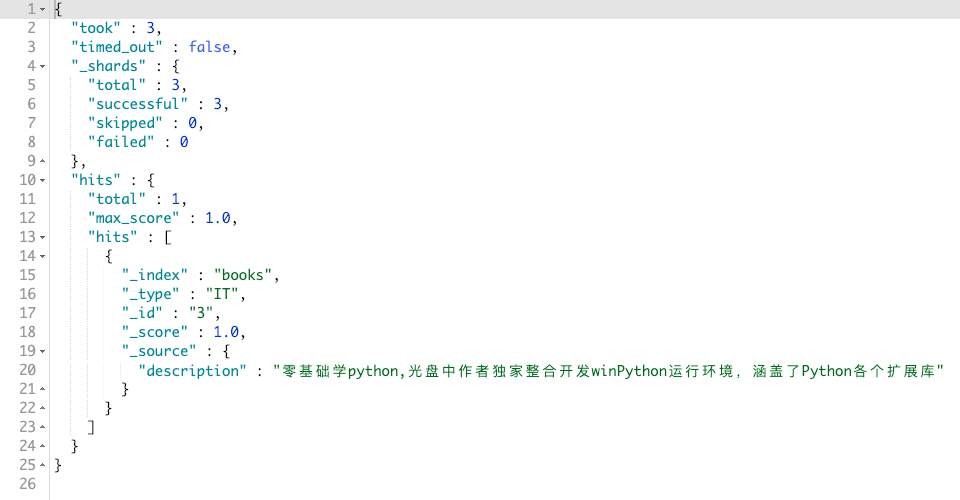
First `Elasticsearch` analyzes `description` into `win` and `python`. Then `wi*` is applied to each term. `win` matches, so it shows up.
If I use `win?`, there are no hits, because `?` means one or more. When it matches `win`, there is nothing after it, so the result is empty.
#### regexp query
This is a regular expression query. The idea is the same as `wildcard`, so I will not go into it here.
#### fuzzy query
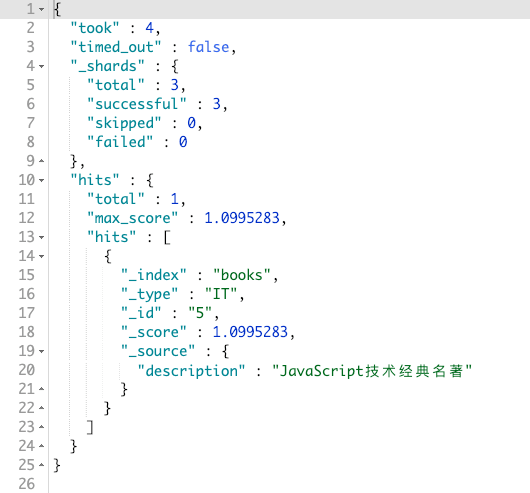
Think of `fuzzy` as a fuzzy query. If a user mistypes a keyword as `javascrpit`, `fuzzy` can still find `javascript`:
```js
GET books/_search
{
"_source": "description",
"query": {
"fuzzy": {
"description": "javascrpit"
}
}
}
```
The result:
### Compound queries
A compound query combines simple queries into a more complex one. It can also control how another query behaves.
#### constant_score query
Not used much. It scores the documents in the result.
I will not go into it here. If you are interested: [[Elasticsearch] 控制相关度 (四) - 忽略 TF/IDF](https://blog.csdn.net/dm_vincent/article/details/42157577)
#### bool query
This query is pretty important. It provides:
- must: the document must satisfy the queries under `must`, like `AND` or `&&`
- should: the document may match the queries under `should`; it is fine if it does not. Like `OR` or `||`
- must_not: the opposite of `must`. Must not satisfy the queries under `must_not`, like `!==`
- filter: same as `must`, but it does not score, so it does not affect `_score`
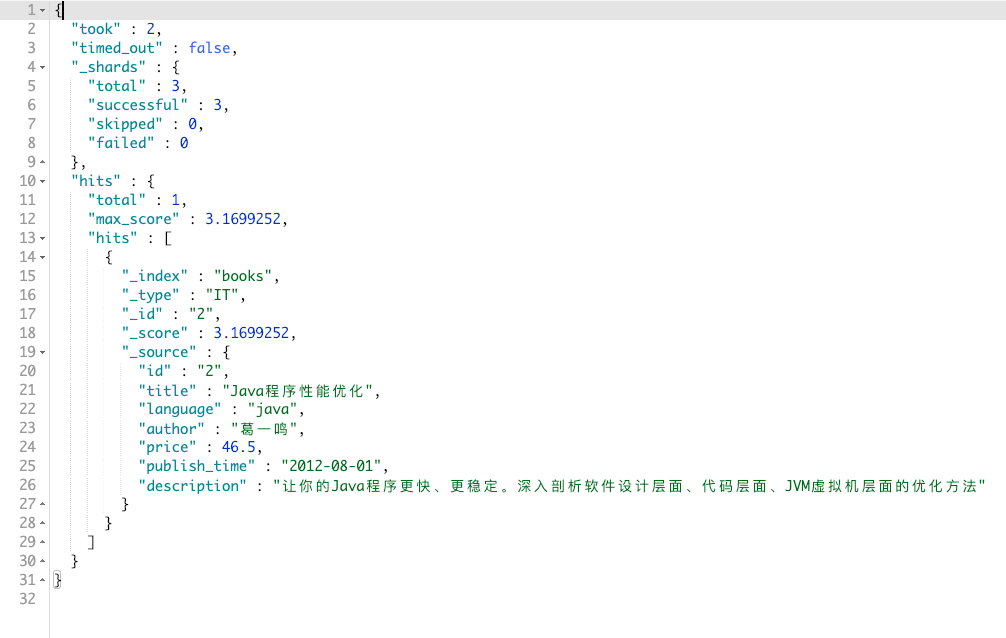
Now I want: author (`author`) is `葛一鸣`, title (`title`) contains `java`, price (`price`) must not be above `70` or below `40`, and description (`description`) may or may not contain `虚拟机`.
```js
GET books/_search
{
"query": {
"bool": {
"filter": {
"term": {
"author": "葛一鸣"
}
},
"must": [
{
"match": {
"title": "java"
}
}
],
"should": [
{
"match": {
"description": "虚拟机"
}
}
],
"must_not": [
{
"range": {
"price": {
"gt": 70,
"lt": 40
}
}
}
]
}
}
}
```
The result:
#### dis_max query, function_score query, boosting query
I will not cover these three. They mainly affect `_score`, which is the score of the query results. Search online if you are interested.