
Dynamically modifying a Protocol Buffers string message
Preface
Requirements changed: we had to move logs that used to go to Alibaba Cloud onto our internal log platform, which speaks Protocol Buffers.
Because reporting used to live on Alibaba Cloud, we let logtail record the user’s request IP for us.
The internal platform’s RESTful API is only a forwarder: the frontend encodes with pb -> sends to the RESTful API -> the server forwards over UDP to the data platform.
So the user’s request IP has to be recorded by that RESTful relay. The problem is the relay is a generic service: it does not turn json into pb. The frontend has to do that. Once the frontend has encoded the log, the relay cannot change it.
That makes it hard for the relay to add an IP.
After thinking it through, three options:
- The frontend fetches the IP by requesting a third-party resource
- The relay does the encoding
- The relay patches the pb message
The first was ruled out immediately: CDN and other issues, too many things we don’t control
The second isn’t great either. As I said, this is a generic service. If we encode here, every pb payload would have to be encoded on the relay later, and it would be slow
So we have to go with the third option.
Notes on string encoding
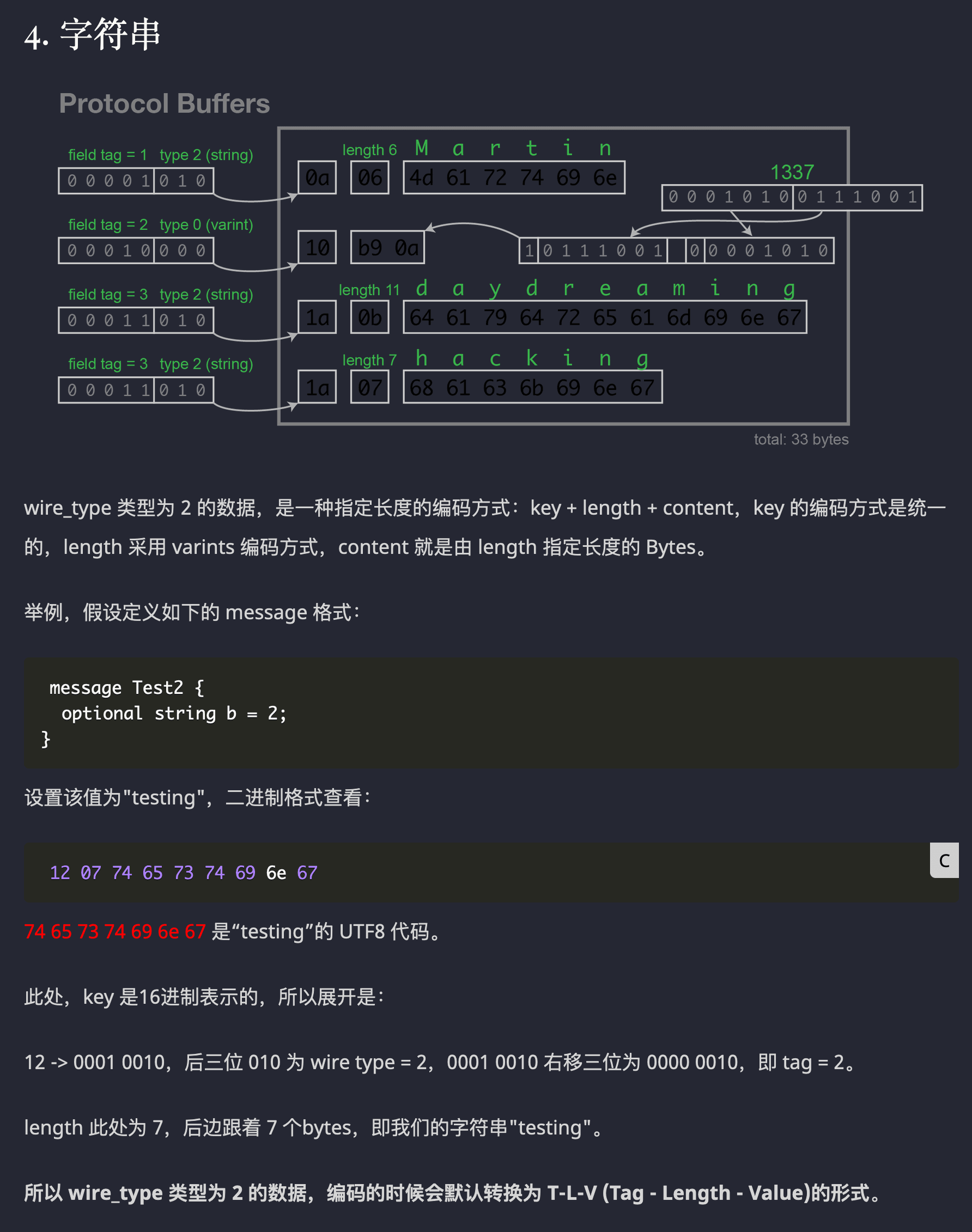
Before we fix it, one thing has to be true: the IP is a string. So we need to know how Protocol Buffers encodes a string message.
I’ll cite a third-party write-up: Protocol Buffer encoding: strings (opens in a new tab)
For easier reading, here’s a screenshot of the relevant part:
Implementation
Now that we know how it’s encoded, we can patch the bytes.
Here’s the original JSON:
{ "level": "info", "message": "test", "lts": 1622078077630, "clientIP": "__inject-ip__"}Protocol Buffers schema:
syntax = "proto3";
message Log {    int64 lts = 1; // timestamp    string level = 2; // log level    string message = 3; // main log message    string clientIP = 4; // IP}
__inject-ip__ is a placeholder that tells the relay what to patch.
After Protocol Buffers encoding, that JSON object becomes:
08 be f5 8c db 9a 2f 22 04 69 6e 66 6f 2a 04 74 65 73 74 3a 0d 5f 5f 69 6e 6a 65 63 74 2d 69 70 5f 5f5f 5f 69 6e 6a 65 63 74 2d 69 70 5f 5f is the hex encoding of __inject-ip__
Per that article, the 3a 0d in front is required Protocol Buffers metadata
- 3a is the field type and ID
- 0d is the value length
So we only need to care about 0d and 5f 5f 69 6e 6a 65 63 74 2d 69 70 5f 5f
Suppose the relay sees the user’s IP as 127.0.0.1
Then we should change 0d to hexadecimal(len(127.0.0.1)), and change 5f 5f 69 6e 6a 65 63 74 2d 69 70 5f 5f to hexadecimal(127.0.0.1)
With the mechanics clear, we can write it:
package main
import (  "encoding/base64"  "encoding/hex"  "fmt"  "strings")
func main() {  // base64 representation of the pb Buffer (byte => base64)  payloadBase64 := "CMK+w7XCjMObwpovIgRpbmZvKgR0ZXN0Og1fX2luamVjdC1pcF9f"
  // decode base64  payload, err := base64.StdEncoding.DecodeString(payloadBase64); if err != nil {    panic(err)  }
  // string to hex  // 08C2BEC3B5C28CC39BC29A2F2204696E666F2A04746573743A0D5F5F696E6A6563742D69705F5F  payloadBinaryStr := fmt.Sprintf("%X", payload)
  // hex of the __inject-ip__ placeholder  ipPlaceholder := "5F5F696E6A6563742D69705F5F"
  // index where the placeholder appears  placeholderIndex := strings.Index(payloadBinaryStr, ipPlaceholder)
  // the user's IP  clientIP := "127.0.0.1"
  // hex of clientIP  clientIPBinaryStr := fmt.Sprintf("%X", clientIP)
  // length of the IP (in hex), used to modify the length of clientIP in the pb  // because the max length of an IP address is 15 (255.255.255.255), which is no more than 255, we can guarantee clientIPLen is always 2 hex digits (i.e. one byte)    // %02 also ensures that if there are fewer than 2 digits, it is left-padded with a zero  clientIPLen := fmt.Sprintf("%02X", len(clientIP))
  payloadBinaryStrPrefix := payloadBinaryStr[:placeholderIndex - 2]  payloadBinaryStrSuffix := payloadBinaryStr[placeholderIndex + len(ipPlaceholder):]  payloadBinaryStrNewContent := clientIPLen + clientIPBinaryStr
  // 08C2BEC3B5C28CC39BC29A2F2204696E666F2A04746573743A093132372E302E302E31  // as you can see, the previous 0D has now been replaced with 09  payloadBinaryStr = payloadBinaryStrPrefix + payloadBinaryStrNewContent + payloadBinaryStrSuffix
  payloadBinaryByte, err := hex.DecodeString(payloadBinaryStr); if err != nil {    panic(err)  }
  newPayloadBase64 := base64.StdEncoding.EncodeToString(payloadBinaryByte)
    // CMK+w7XCjMObwpovIgRpbmZvKgR0ZXN0OgkxMjcuMC4wLjE=  fmt.Println(newPayloadBase64)}
Then I changed the original JSON, replaced __inject-ip__ with 127.0.0.1, encoded it with Protocol Buffers again, and the result was identical. So this works.
Reply to this post on X (opens in a new tab)View as Markdown