
Web security overview
Preface
A look at web attacks and how they work, including frontend, backend, and ops.
The backend examples use PHP. After comparing options, PHP is the most obvious language for showing this.
Every attack in this post has a Docker lab so you can research and test it yourself.
This post is a partial recap of my older security writeups, with some cleanup and additions. If you want more, see Freebuf Black-Hole (opens in a new tab).
Frontend
XSS
XSS is executing your JavaScript in someone else’s browser. Everything else is supporting technique.
DOM XSS
Abuse JavaScript’s ability to mutate the DOM.
Where it shows up: separated frontend/backend architectures.
Most developers know not to use eval unless they have to. One reason is security. Does skipping eval mean you are safe? No.
Look at this:
<script> window.open(new URL(location.hash.slice(1)).href)</script>To make this clearer, a short walkthrough:
Suppose the current URL is
http://baidu.com/#http://360.cn. Thenlocation.hash.slice(1)ishttp://360.cn.
new URL(url).hrefparses the URL and returns the parsed href. If the URL fails its internal checks, it throws.
Looks fine, right? new URL() is a built-in. It is supposed to filter for us.
So we break that check. The table below is from the URL spec examples (opens in a new tab):
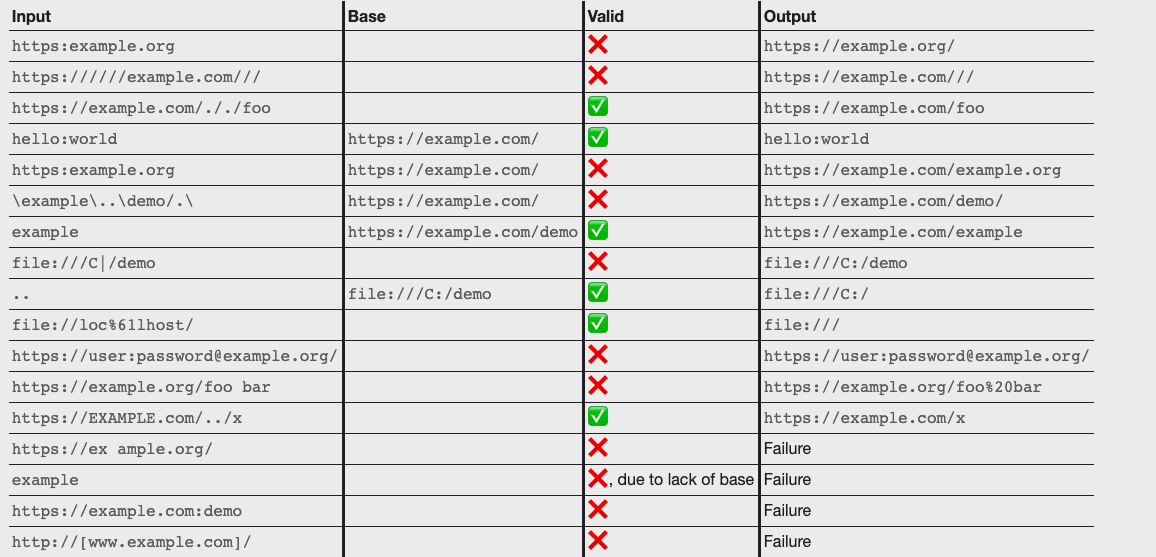
hello:world is valid. And hello: is a JavaScript label, similar to goto in C. Change the URL to http://baidu.com/#javascript:alert(1) and the bug fires.
Docker lab (opens in a new tab)
Backend
Reflected XSS
Caused by missing or mismatched filtering on the frontend or backend.1
Where it shows up: MVC.
In MVC, frontend markup is written in the backend language. On a request, the backend builds the page, then returns the HTML to the browser. If XSS happens in that path, the backend is in the loop, so we usually call it reflected XSS.
PHP:
<?php  // disable the browser's XSS auditor  header("X-XSS-Protection: 0;");
  $bg = $_GET['bg'];  if (empty($bg)) {    $bg = '999';  }  echo "<div style='width: 120px; height: 120px; background-color:#$bg'>I am a little square</div>";?>
It reads bg from the query string and uses it as a background color. Looks fine at first. $bg is attacker-controlled. Close the attribute and you are in:
http://127.0.0.1:8082/?bg=123' onclick='alert(1)
Put that in bg and the markup becomes:
<div style=‘width: 120px; height: 120px; background-color:#123' onclick='alert(1)’>I am a little square</div>
Docker lab (opens in a new tab)
Stored XSS
Reflected XSS, plus a write to the database.
The code:
// get the client's IP address// this code is from: https://stackoverflow.com/questions/3003145/how-to-get-the-client-ip-address-in-php$ipaddress = 'UNKNOWN';$keys = array('HTTP_CLIENT_IP', 'HTTP_X_FORWARDED_FOR', 'REMOTE_ADDR');foreach($keys as $k) {  if (isset($_SERVER[$k]) && !empty($_SERVER[$k])) {    $ipaddress = $_SERVER[$k];    break;  }}
// get the content and encode/filter it$content = htmlspecialchars($_POST['content'], ENT_QUOTES);
$sql = "INSERT INTO xss.message (content, ip) VALUES ('$content', '$ipaddress')";$conn->query($sql);
Looks fine. We already encode-filter content.2
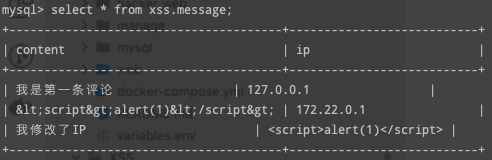
Even if we submit HTML, it is escaped. Submit <script>alert(1)</script> and the database stores <script>alert(1)</script>
No way around it? There is.
The code also stores the client IP. That is the bug. CLIENT-IP and X_FORWARDED_FOR are user-controlled. Install the ModHeader (opens in a new tab) extension:
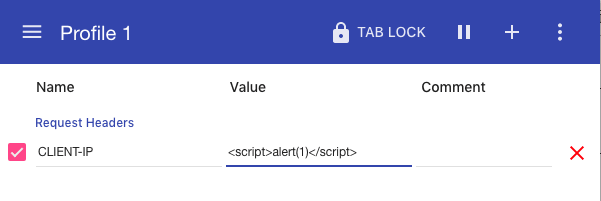
Change the header, submit again, and it is stored unescaped:
Docker lab (opens in a new tab)
CSRF
Think of CSRF as making someone else do the killing. It usually shows up in form submissions. Open-source projects, especially CMS software, are common.
<form method="post" action="addAdminUser.php"> <div class="input-group"> <label for="username">Admin account to add: </label> <input type="input" name="username"> </div> <div class="input-group"> <label for="password">Admin password to add: </label> <input type="password" name="password"> </div> <div class="input-group"> <button type="submit">Add</button> </div></form>The form lives in the admin backend and adds an admin account. addAdminUser.php checks the current user’s cookies. Non-admins cannot add anyone.
The form has no captcha and no token, and addAdminUser.php does not check Referer.
That is a CSRF bug.
When the browser requests a resource, it attaches unexpired cookies. So a request to add an admin from another site still carries the logged-in cookies. The server treats it as you (the cookie check passed).
Why CORS does not help: this kind of request cannot read the response, so CORS does not block it. An Ajax request would be blocked, because Ajax can read the response.
Besides form, what else works? The W3C CORS spec says:
A simple cross-origin request (opens in a new tab) has been defined as congruent with those which may be generated by currently deployed user agents that do not conform to this specification. Simple cross-origin requests generated outside this specification (such as cross-origin form submissions using
GETorPOSTor cross-originGETrequests resulting fromscriptelements) typically include user credentials (opens in a new tab), so resources conforming to this specification must always be prepared to expect simple cross-origin requests with credentials.––See w3c cors (opens in a new tab) for details.
That is a bit vague, so here is the extra: form submissions with GET or POST, and GET requests caused by HTML tags such as a and img, almost always carry user credentials (cookies).
Docker lab (opens in a new tab)
SSRF
SSRF is not far from CSRF. CSRF targets the user on the client. SSRF targets the server itself.
It usually shows up in features that fetch and return a user-controlled resource.
Examples: view page source online, fetch the title of a user-supplied link, translate a page online.
<script>  // dynamically build the url from the url  function seeCode() {    const url = document.getElementsByTagName('input')[0].value;    location.href = location.origin + location.pathname + '?url=' + url  }</script>
<input type="text" placeholder="Enter the URL of the site whose source you want to view"/><button onclick="seeCode()">View</button><?php  $url = $_GET['url'];  if ("" == trim($url)) {    return;  }
  // get the content  $websiteCode = file_get_contents($url);
  // encode and store into the textarea  echo "<textarea>".htmlspecialchars($websiteCode, ENT_QUOTES)."</textarea>";?>
There is no filtering of user input. You can pass http://192.168.1.2 and reach an internal host. The fetch runs on the server, and the server can reach other machines on the same LAN.
Docker lab (opens in a new tab)
JSON hijacking
JSON hijacking is the same idea as CSRF.3
The main difference from CSRF is that JSON hijacking also abuses JSONP.
<?php  require 'utils.php';
  // authenticate the user and fetch user info  $result = getUserInfo();  if (count($result) != 3) {    echo "";    exit();  }
  $fnName = $_GET['callback'];  if ("" == trim($fnName)) {    echo "";    exit();  }
// outputs: getInfo({"name": name, "balance": balance }); echo "$fnName({name: '$result[0]', balance: '$result[2]'})";?><script> function getInfo(data) { console.log(data); // {"name": name, "balance": balance} }</script><script src="./json.php?callback=getInfo"></script>If an attacker hosts a page that also includes <script src="http://xxx/json.php?callback=getInfo"></script>
Per the W3C CORS spec above, if the user is already logged in and then opens the attacker’s link, the attacker can read sensitive data they should not have.
Docker lab (opens in a new tab)
Footnotes
-
DOM XSS is a kind of reflected XSS. People usually just say reflected XSS, and only split them when they need a finer cut. ↩
-
htmlspecialchars(string,ENT_QUOTES)encodes like this:&becomes&,"becomes",'becomes',<becomes<,>becomes>. ↩ -
Same in the sense that the bug is born the same way: requests from tags still carry user credentials. ↩
Reply to this post on X (opens in a new tab)View as Markdown